When choosing between Pilates vs yoga, you can’t base your decision on opinion alone (we are a Pilates studio, after all). You’re going to find vocal supporters for both systems of disciplines, so what matters most is what you’re looking to get out of the experience. Choosing between Pilates and yoga affects your core strength development, flexibility training, mental focus and overall fitness results. The right practice depends on your fitness goals, injury history and whether you prefer structured movement or flowing sequences.
For many people, Pilates is a better foundation for stronger core muscles, better posture, leaner muscles and measurable physical progress. Yoga can be an excellent complement, especially if you want deeper stretching, meditation or a more spiritual pursuit. The fact of the matter is that the two disciplines are both demanding and beneficial in their own right. In either world, you’re going to challenge yourself and push your body to its limits. Either can make you feel more empowered, focused, or energized. And you’re going to get a personal sense of satisfaction from both Pilates and yoga.
Below is a comprehensive comparison of Pilates vs yoga to help you make an informed decision about which is better suited to you and your goals.
Pilates vs Yoga: The Key Differences
The main difference is how each practice approaches movement, strength and the mind-body connection.
- Pilates focuses on muscle toning, body control and core strength, while yoga emphasizes flexibility and the use of broad muscle groups.
- Yoga is generally more focused on mindfulness and deep breathing, while Pilates emphasizes controlled movements and core engagement.
- Pilates focuses on core stabilization, precise movements, postural alignment and functional strength.
- Yoga focuses on breath work, flexibility and mind-body connection through flowing sequences or held yoga poses
- Both Pilates and yoga are low-impact workouts that can support physical and mental health, but they often produce different outcomes.
Both yoga and Pilates can improve body awareness, reduce stress and support better movement quality. The difference is that Pilates tends to be more structured and strength-oriented, while yoga tends to be more expansive, breath-led and relaxation-focused.
If your priority is core strength, muscle tone, posture or rehabilitation, Pilates usually offers the more direct route. If your priority is deep stretching, meditation, spiritual awareness or relaxation, you may choose yoga as your main practice.
Origins and Underlying Philosophies
Pilates and yoga have distinct origins that shape their unique approaches. Pilates, developed in the early 20th century by Joseph Pilates, was created as a rehabilitation method for injured soldiers and dancers, focusing on controlled movements, core strength, and muscular alignment rather than spiritual growth. Its core principles—precision, flow, control, concentration, center, and breathing—provide a structured framework that guides each exercise, emphasizing measurable progress and body awareness.
In contrast, yoga dates back over five thousand years to ancient India and is deeply rooted in Hindu philosophy. It combines physical poses, breath control, meditation, and spiritual awareness through styles such as Vinyasa and Hatha yoga. While yoga integrates the mind and body through meditation and breathwork, Pilates prioritizes physical conditioning and core control. At Boom Pilates, we emphasize Pilates because it offers a clear, logical, and tangible framework that connects posture, breathing, and core stability for effective, focused results.
Movement Style and Technique
Pilates and yoga both use mindful movement, but their movement styles are very different.
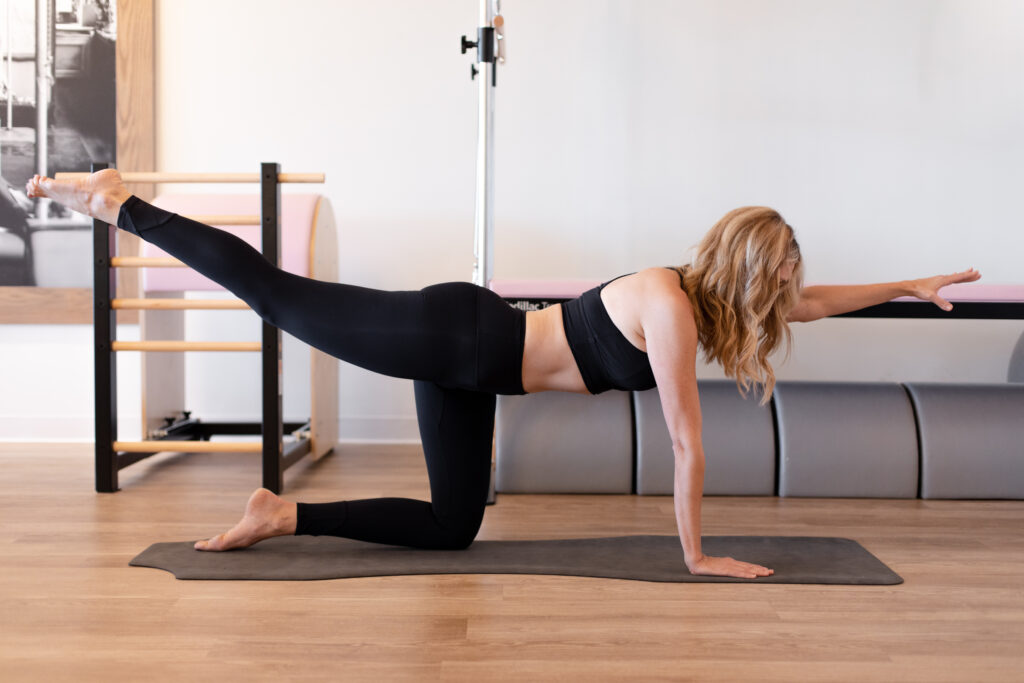
Pilates uses small, precise movements targeting specific muscle groups. A Pilates class may focus on the deep abdominal muscles, pelvic floor, glutes, spinal stabilizers and shoulder alignment. The goal is not to force the body into a shape, but to move with control, proper form and deliberate muscle activation.
Yoga flows through sequences or holds static poses for flexibility. In Vinyasa yoga, movement is often linked continuously with breath. In Hatha yoga, poses may be held longer with more attention to alignment. In restorative yoga, bolsters and props support the body, allowing the nervous system to settle.
Pilates emphasizes control of the starting position and proper alignment. Before a movement begins, a certified instructor may cue your pelvis, rib cage, spine, neck and shoulders so the right muscles do the work. This is especially useful for people with chronic pain, neck pain, muscle tension or postural habits from long hours sitting.
Yoga focuses on breath-synchronized movement patterns. In yoga, breathwork is used to promote relaxation and support holding poses. In Pilates, breath is utilized to energize the muscles for effective exercise.
Breath plays a central role in both yoga and Pilates, but it is used differently: yoga emphasizes breath synchronization with movement, while Pilates focuses on breath to activate the core and support muscle engagement. Both yoga and Pilates incorporate breathing techniques, but yoga typically places greater emphasis on breath awareness throughout the practice than Pilates.
Core Strength and Toning Benefits
Pilates has a clear advantage when the goal is core strength, muscle tone and stronger body control.
Pilates specifically targets deep core muscles, the pelvic floor and spinal stabilizers. Pilates is particularly effective for toning the midsection and improving muscular balance, as every movement originates from the “powerhouse”-the deep abdominal muscles, pelvic floor and lower back.
Structured Pilates exercises build functional strength and visible muscle tone because the work is precise and progressive. In mat Pilates, you use body weight to create resistance. In reformer Pilates, springs and the reformer machine add controlled resistance that helps build lean muscles while improving posture and alignment.
Yoga provides some core work, especially in plank-based sequences, balancing postures, downward dog transitions and stronger styles such as power or Vinyasa yoga. However, yoga traditionally focuses more on flexibility and broad muscle groups, while Pilates emphasizes muscle toning, body control and core strength.
This is where Pilates vs yoga becomes especially practical. If you want faster, more noticeable results in core strength, Pilates usually offers a more targeted plan. Most classes are designed around progression, so you can feel when your core engagement, endurance and control improve.
Pilates may also support overall fitness goals indirectly by helping you build lean muscle, burn calories through controlled resistance work, and improve your movement efficiency. Yoga exercises can also burn calories, but the effect depends heavily on the style, pace and intensity of the yoga classes.
Flexibility and Mobility
Yoga is traditionally known for flexibility, but Pilates builds a different and highly useful type of mobility.
Yoga traditionally emphasizes deep stretching and range of motion. Many yoga poses use longer holds to lengthen connective tissues, open the hips, improve shoulder mobility and increase joint range. Both Pilates and yoga improve flexibility, but yoga is generally more focused on this goal, utilizing deep stretches and longer holds to increase joint mobility.
Pilates builds flexibility alongside strength for better functional movement. Instead of simply stretching into a position, Pilates teaches you to control your range. This matters because flexibility without strength can sometimes make joints feel unstable, especially for people with hypermobility, certain health conditions or previous injuries.
Pilates prevents injury through balanced flexibility and stability. A reformer Pilates session, for example, can use springs, ankle weights, a Pilates ring or other Pilates equipment to support movement while strengthening the muscles around the joint.
Dynamic stretching in Pilates supports athletic performance better than static yoga stretches for many people because it trains control through movement. Athletes often benefit from Pilates because it improves core stability, balance, muscular alignment and coordination without overloading the body.
Yoga still has an important place. If your body type or personal preference leans toward slower stretching, deep breathing and relaxation, yoga may feel more natural. But if your goal is mobility for daily life, sport or rehabilitation, Pilates places a strong emphasis on strength-through-range.
Equipment and Accessibility
Equipment is one of the clearest practical differences between Pilates and yoga.
Pilates offers both mat work and specialized equipment, such as reformers. Pilates can be performed on a mat or with specialized equipment, including springs, levers and bodyweight for resistance.
Equipment-based Pilates provides resistance training and precise muscle targeting. Pilates equipment, such as the Reformer machine, adds resistance to workouts, making them more effective for building strength and improving posture. This is why reformer Pilates is so popular among people who want muscle tone, improved posture and a more guided training experience.
The original Pilates method incorporates various machines such as the barrel, chairs and foot corrector to support balance and flexibility. Modern studios may also use the Cadillac, Wunda chair, Pilates ring, resistance bands, small balls and other tools to create different variations for different fitness goals.
Yoga requires minimal equipment, primarily mats and basic props. In yoga, props like blocks, straps and bolsters are commonly used to assist with poses and enhance the practice. A yoga studio may offer these props for Hatha yoga, Kundalini yoga, restorative yoga or other yoga classes.
Pilates equipment also allows for modifications, making it accessible for injuries and limitations. Springs can assist a movement or make it harder. The reformer machine can support the spine while still challenging the core muscles. This makes Pilates classes especially useful for beginners, older adults, pregnant women with medical clearance, and people managing medical issues or chronic pain.
Mental Focus and Stress Relief
Both practices offer mental benefits, but they approach mental focus in different ways.
Yoga emphasizes meditation, spirituality and stress reduction. Yoga’s integration of breathwork, meditation and relaxation techniques makes it highly effective for calming the nervous system and relieving anxiety, especially in styles like restorative yoga and Yin yoga.
Pilates develops mental focus through precise movement concentration. You have to pay attention to your alignment, breathing techniques, core engagement and control. The concentration involved in Pilates can create mental clarity by pulling your attention away from distractions and into your body.
Both Pilates and yoga can improve mental health by promoting mindfulness and reducing symptoms of anxiety and depression, but yoga often incorporates more meditation and relaxation techniques. Both yoga and Pilates can help with anxiety and depression by slowing everything down and promoting mindfulness, which enhances self-care and alignment.
Regular participation in Pilates or yoga can boost serotonin levels, lower cortisol, the stress hormone, and improve overall emotional resilience, contributing to better mental wellness.
The difference is in motivation style. Yoga may help you reduce stress through stillness, deep breathing and connection to the inner self. Pilates can reduce stress while also building confidence through strength gains.
Pilates vs Yoga: Which Should You Choose?
If your goal is targeted core strengthening, postural improvement, and measurable fitness gains, Pilates is an excellent choice. It excels at building core strength, muscle tone, lean muscle mass, improved alignment, body control, and functional strength.
Pilates is also particularly valuable for rehabilitation, back pain relief, and building functional strength. Its structured method, clear progression, and adaptable exercises with specialized equipment make it ideal for those seeking a focused and modifiable practice.
On the other hand, yoga might resonate more with you if you enjoy flowing movement, meditation, and spiritual pursuits. It’s a great fit for those seeking deep breathing, longer stretches, relaxation, spiritual awareness, or a stronger connection to the inner self.
Many find that combining the two practices works wonderfully, with Pilates as the foundation for strength and yoga to enhance flexibility and mindfulness. At Boom Pilates, we often recommend starting with Pilates to build core stability, improve posture, and develop strength. Then, if you’re drawn to it, adding yoga can provide additional mobility, relaxation, and mental benefits.
Both Pilates and yoga offer valuable physical and mental health improvements. But if you’re after a clear, strength-focused practice that helps you move better in everyday life, Pilates truly stands out.
The BOOM Difference
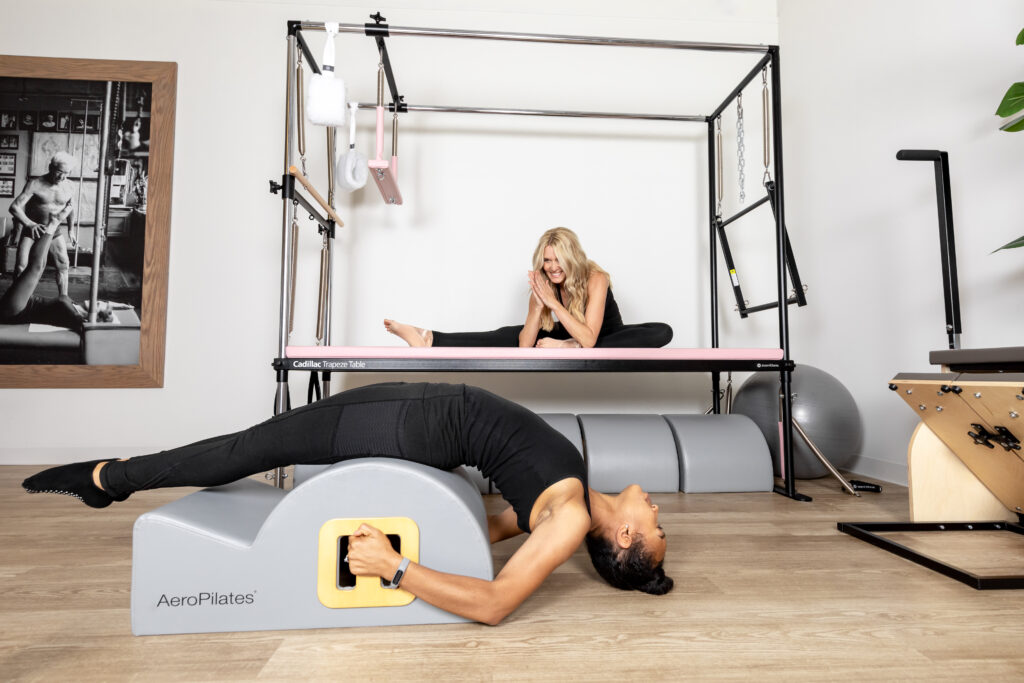
Boom Pilates gives participants access to seven specialized pieces of Pilates equipment, including the popular Reformer and Cadillac, also known as the trapeze table. Our custom-built pink trapeze table, the “Pink Cadillac,” has become a signature part of the studio experience.
At Boom Pilates, classes are built around custom choreography, upbeat music, and intentional movement designed to create an energetic, full-body workout. By combining traditional Pilates principles with rhythm and variety, each session feels engaging, challenging, and far from repetitive.
Our classes are designed for every experience level, from beginners to seasoned Pilates enthusiasts. Each movement includes modifications and progressions, and our instructors complete more than 500 hours of training to ensure every client receives thoughtful guidance and support.
At the end of each session, we transition into a mindful cooldown designed to help you reset and recover. The lights dim, the music softens, and the class slows into lighter, restorative movement. While it’s not rooted in traditional yoga practices, it creates a calm, communal finish that helps balance the workout’s energy and leaves you feeling refreshed before you head back into your day.
Ready to settle the debate of yoga vs Pilates? Find out for yourself! Sign up for a class at our St Louis Pilates studio and discover what sets Pilates apart.